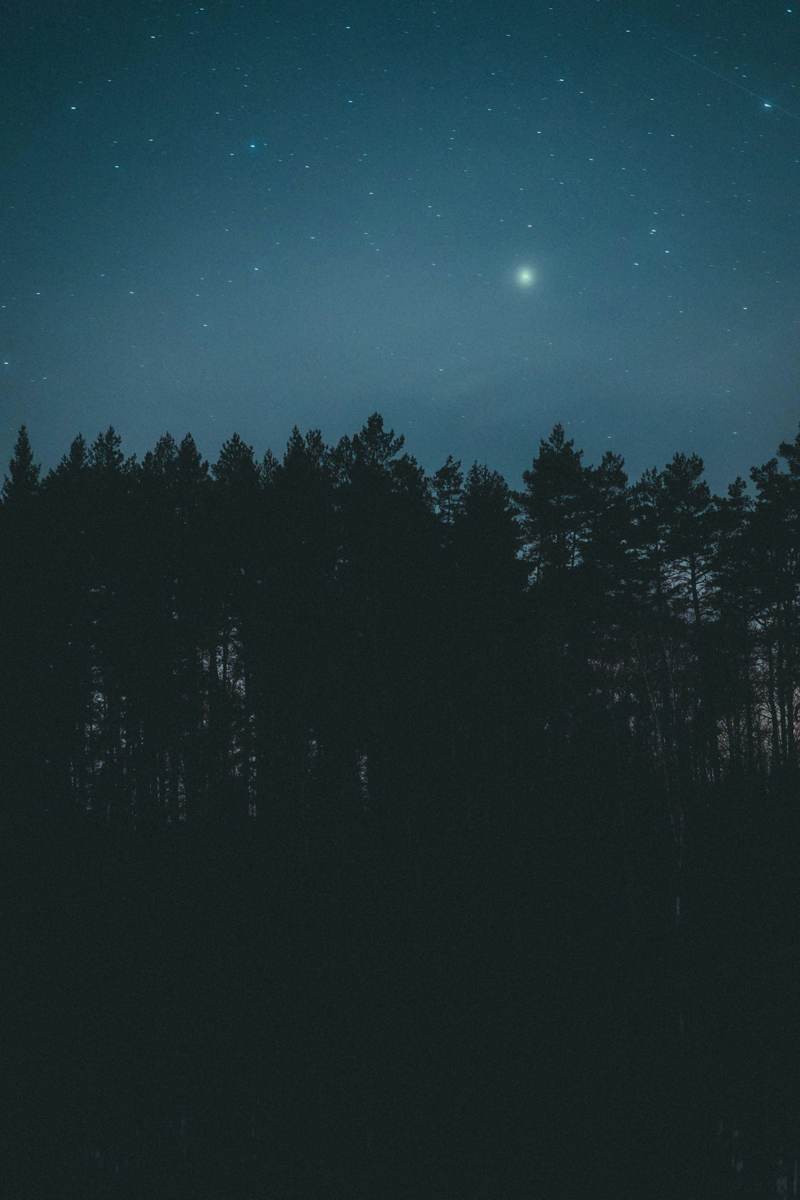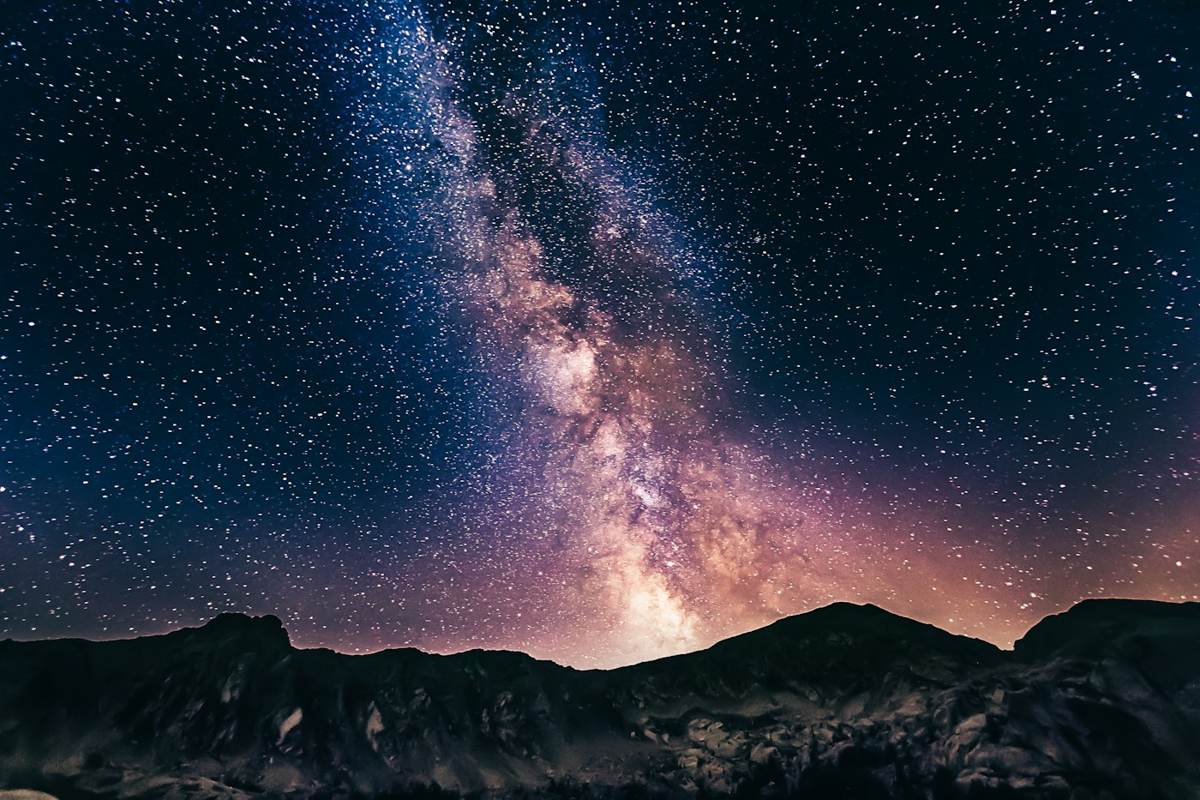
Hold a grain of sand at arm's length against the night sky. In 2022 NASA's James Webb Space Telescope looked at a patch of sky about that size and photographed thousands of galaxies in it. Each galaxy holds billions of stars. That one grain of sky was only a sample.
Most of us can picture a hundred people, perhaps a thousand. Nobody can really picture a hundred billion. So this episode does what scientists do: it climbs the ladder of scale one rung at a time, and stops now and then to ask what it feels like to be this small in something this large.
“The creation of the heavens and the earth is greater than the creation of humankind, but most people do not know.”
Qur'an 40:57 · our rendering
The verse sits in a passage answering people who doubted that God could raise the dead. Its argument is about scale: if the heavens and the earth are the bigger work, then remaking one human being is the smaller thing. It asks the reader to measure themselves against the sky, not to feel worthless, but to see clearly.
What science shows
Start with the Earth. It is about 12,700 kilometres across. Light, the fastest thing there is, could go round it seven times in a second. Now step out to the Sun, about 150 million kilometres away. Its light takes around 8 minutes 20 seconds to reach us, so when you see the Sun you see it as it was eight minutes ago.
Next rung: the nearest star beyond the Sun, Proxima Centauri, is 4.2 light years away. A light year is the distance light travels in a year, about 9.5 million million kilometres. NASA's Voyager 1, launched in 1977 and now the most distant human-made object, has travelled more than 24 billion kilometres. At its speed it would still need over 70,000 years to cover the gap to Proxima.
The Sun is one star in the Milky Way, a spiral galaxy roughly 100,000 light years across that holds somewhere between 100 and 400 billion stars. Our galaxy, in turn, is one of a cluster, and that cluster sits inside a supercluster called Laniakea, mapped in 2014 by Brent Tully and colleagues, which spans about 500 million light years.
How many galaxies are there? In 2019 the Hubble Legacy Field combined 16 years of Hubble images into one picture containing about 265,000 galaxies. A widely reported 2016 study estimated that the observable universe could contain up to two trillion galaxies. Later measurements from the New Horizons spacecraft, far from the Sun's glare, suggested the true number is lower, in the hundreds of billions. Either way, it is an ocean of galaxies.
The observable universe is the part whose light has had time to reach us since the Big Bang, about 13.8 billion years ago. Because space has been expanding all that time, its edge is now about 46 billion light years away in every direction, giving a sphere roughly 93 billion light years across. Beyond that, there is almost certainly more, but its light has not reached us.
Go the other way, and the ladder keeps going down. A human hair is about 80 micrometres thick. A red blood cell is about 7 micrometres. An atom is about a tenth of a nanometre, and its nucleus is about 100,000 times smaller again. The Eames film Powers of Ten (1977) travels both directions in nine minutes. Somewhere in the middle of all those rungs sits a person on a picnic blanket, which is us.
What each faith says
Judaism
“When I behold Thy heavens, the work of Thy fingers, The moon and the stars, which Thou hast established; What is man, that Thou art mindful of him? And the son of man, that Thou thinkest of him?”
Psalm 8:4-5 (8:3-4 in many English Bibles) · JPS 1917
The Hebrew Bible often sends people outside to look up. Psalm 8 sets the size of the sky against the smallness of a human being, and then turns the question round: if the heavens are so vast, why does God pay attention to us at all? The psalm answers that humans are made 'but little lower than the angels', crowned with glory. Smallness and dignity sit side by side.
Jewish thinkers also measured the sky. Levi ben Gershon (Gersonides, 1288 to 1344), a rabbi and astronomer in Provence, invented a measuring tool later called Jacob's staff and argued that the stars were far more distant than people assumed. Maimonides (1138 to 1204) taught that thinking about the size and wisdom of creation leads a person to love God and to feel their own smallness (Mishneh Torah, Foundations of the Torah 2:2).
Christianity
“Lift up your eyes on high, and see who has created these, who brings out their army by number. He calls them all by name. by the greatness of his might, and because he is strong in power, Not one is lacking.”
Isaiah 40:26 · WEB
Christians share Psalm 8 and also the invitation of the prophet Isaiah (peace be upon him) to count the stars. In the New Testament, Paul writes that God's 'everlasting power and divinity' can be seen in the things that are made (Romans 1:20). For many Christians the size of the universe is not a threat to faith but an enlargement of it: the bigger the cosmos turns out to be, the bigger their sense of its Maker.
Christian tradition also holds that this vast God is close and personal, known through Jesus (peace be upon him), whom Christians believe to be God made human. To a Christian, the God of the galaxies taking human form is the deepest surprise of all.
Islam
“Look again: do you see any cracks? Then look again and again; your sight will come back to you dazzled and tired.”
Qur'an 67:3-4 · our rendering
The Qur'an repeatedly asks its listeners to look at the sky and then look again. Surah al-Mulk says: 'You will not see any flaw in the creation of the Most Merciful. Look again: do you see any cracks? Then look again and again; your sight will come back to you dazzled and tired' (67:3-4, our rendering). The sky is presented as a sign to be read, not a ceiling.
Muslim scholars took the invitation literally. Al-Biruni (973 to c.1050) worked out the radius of the Earth from the dip of the horizon seen from a mountain in what is now Pakistan, and came within about 1 per cent of the modern value. In Islamic belief, God is al-Kabir, the Great, and al-Wasi', the Vast. However large the universe, it is still creation, and its Creator is greater.
Same and different
All three traditions use the sky to teach humility and gratitude, and all three say the size of creation points beyond itself. They differ on how God comes close: Judaism through covenant and the Torah, Christianity through the belief that God became human in Jesus, Islam through revelation to prophets and God's nearness, 'closer than the jugular vein' (Qur'an 50:16), without any incarnation.
A moment to reflect
- When did you last feel small in a good way?
- Does the size of the universe make human life seem less important to you, or more surprising?
- Why do you think so many scriptures ask people to look up at the sky?
- If we can only ever see part of the universe, what does that suggest about the limits of what we know?
Watch
The classic nine-minute journey out to the edge of the known universe and back into a carbon atom.
Real astronomical data from the Himalayas out to the afterglow of the Big Bang, calm and factual.
Fifty seconds pulling back across 265,000 galaxies in one Hubble image.
A short animated lesson on where we sit on the scale of the universe, good for classrooms.
Do it together
Unroll a toilet roll down a corridor or park path with the Sun at sheet 0 and mark the planets at scale (Earth at about 2.5 sheets, Neptune at about 75). Then ask: at this scale, where would the nearest star go? (Hundreds of kilometres away.)
Go somewhere away from street lights on a clear night, with flasks and blankets. Find the Milky Way and Andromeda (the most distant thing most people can see without a telescope, about 2.5 million light years away), then share one verse or reflection each from your tradition.
Give everyone a single grain of sand and show the Webb deep-field image. Hold the grain at arm's length against the image and discuss what it means that this is a tiny sample of the sky.
Go deeper
- Hubble Legacy Field (ESA/Hubble) · museum
- The universe (NASA Science) · article
- Powers of Ten (Eames Office) · article
- Psalm 8 (Sefaria, Hebrew and English) · scripture
- Surah al-Mulk 67 (Quran.com) · scripture
- Play: the ladder of scale · article
Sources (11)
- Webb's first deep field covers a patch of sky about the size of a grain of sand at arm's length: NASA, 2022
- Hubble Legacy Field contains about 265,000 galaxies from 16 years of data: ESA/Hubble heic1909, 2019
- Sunlight takes about 8 minutes 20 seconds to reach Earth: NASA Science, Sun facts
- Voyager 1 distance and mission status: NASA JPL Voyager mission status
- Milky Way about 100,000 light years across with 100 to 400 billion stars: NASA Science, Milky Way
- Laniakea supercluster mapped in 2014: Tully et al., Nature 513, 71-73 (2014)
- Up to two trillion galaxies estimate: Conselice et al., Astrophysical Journal 830 (2016)
- New Horizons sky darkness suggests fewer galaxies than two trillion: Lauer et al., Astrophysical Journal 906 (2021)
- Observable universe about 93 billion light years across; age 13.8 billion years: ESA Planck results; NASA WMAP universe age
- Al-Biruni's measurement of the Earth's radius: Britannica, al-Biruni
- Gersonides, astronomer and inventor of the Jacob's staff: Stanford Encyclopedia of Philosophy, Gersonides