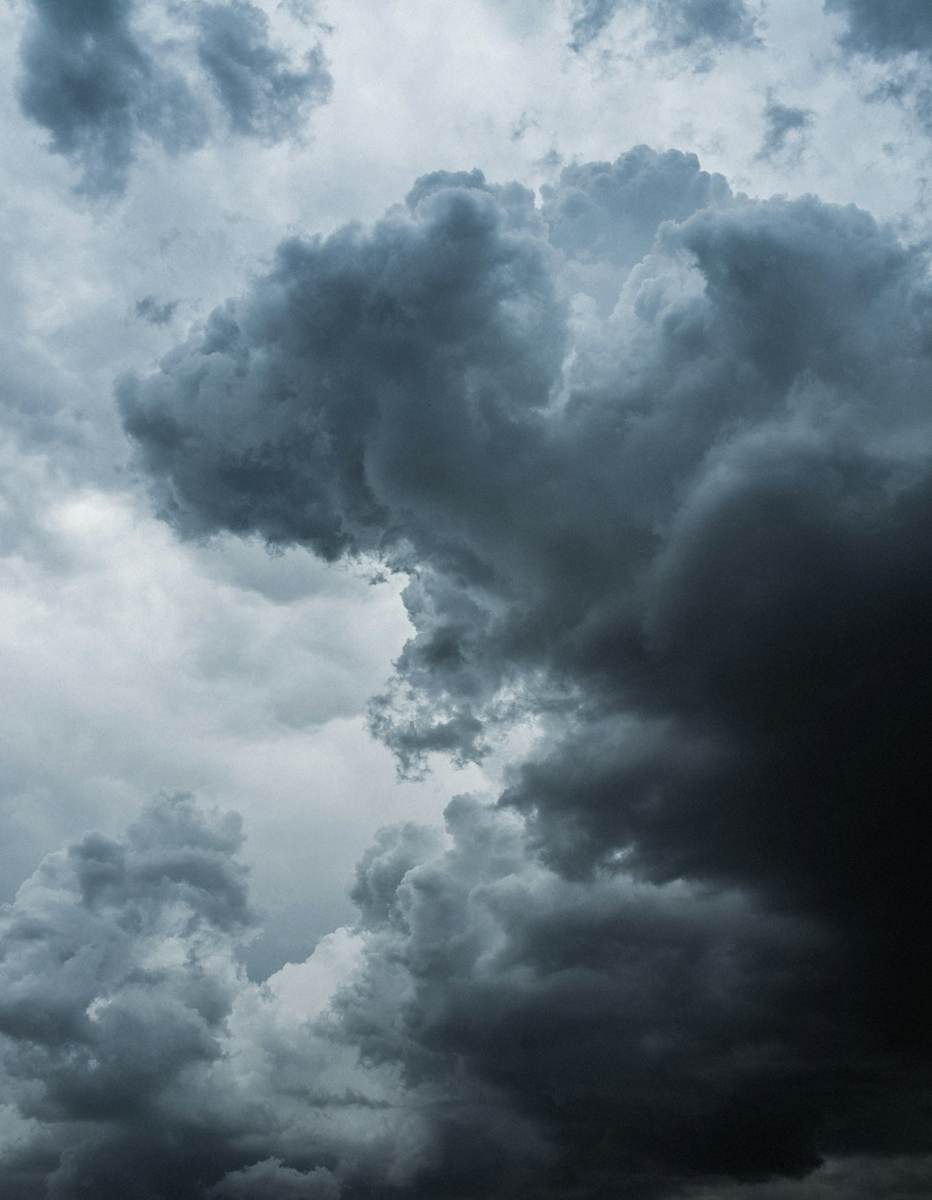
An ordinary fluffy cumulus cloud can weigh around 500 tonnes, roughly the weight of 80 elephants, and it floats. The water in it is spread into billions of droplets so tiny that rising air holds them up. When they grow big enough, they fall as rain.
That water is not new. The same water has been circling between sea, sky and land for billions of years. The cup of tea you drink today contains molecules that have fallen as rain countless times, been locked in ice, run down rivers and risen again as vapour. Every raindrop is a traveller.
“God is the One who sends the winds, which stir up clouds; then He spreads them across the sky as He wills and breaks them into fragments, and you see the rain coming out from within them. When He makes it fall on whichever of His servants He wills, they rejoice.”
Qur'an 30:48 · our rendering
Surah ar-Rum describes rain as a sign of God's mercy: winds go out as 'bearers of good news' before it (30:46), dead land comes back to life after it (30:50). The verse moves step by step, wind, cloud, spreading, breaking, rain, and ends with a human response: joy. The site's signs/rain page explores rain further.
What science shows
The water cycle is driven by the Sun. Its heat evaporates water from oceans, lakes and land, and plants breathe out water vapour from their leaves (transpiration). The vapour rises, cools and condenses around tiny specks of dust, salt or pollen to form cloud droplets. When droplets merge and grow heavy, they fall as rain, snow or hail. The water then runs into rivers, soaks into the ground or freezes into ice, and eventually returns to the sea.
The numbers are huge. Each year roughly 500,000 cubic kilometres of water evaporates from the Earth's surface, most of it from the oceans. Evaporation leaves the salt behind, so the oceans act as a giant natural still, and rain falls fresh. About 90 per cent of water vapour in the air comes from the oceans, seas and lakes; most of the rest comes from plants.
Water spends very different amounts of time in each part of the cycle. A molecule stays in the atmosphere for about nine days on average. It might stay in a river for weeks, in a large lake for decades, in deep groundwater for thousands of years, and in the Antarctic ice sheet for hundreds of thousands. Ice cores drilled in Antarctica contain air and snow up to about 800,000 years old.
Raindrops are not tear-shaped. Small ones are nearly round. Larger ones flatten on the bottom as they fall, like the top of a burger bun, and drops bigger than about 4.5 millimetres usually break apart. NASA's Global Precipitation Measurement mission measures the size and spread of rain and snow from space every half hour.
For centuries people argued about where rivers come from. Many thought rainfall was far too little to feed them, and imagined underground channels from the sea. In 1674 the French lawyer and scientist Pierre Perrault measured rain and river flow in the Seine basin and showed that rain was more than enough. In 1687 Edmond Halley calculated evaporation from the Mediterranean and showed it could supply the rivers flowing into it. The modern water cycle was born.
The cycle is changing as the climate warms. Warmer air can hold about 7 per cent more water vapour for every degree Celsius of warming, so heavy downpours become more intense, while some regions face longer droughts. The UK Met Office records that the most intense rainfall events in Britain have become more frequent since the 1960s.
What each faith says
Judaism
“All the rivers run into the sea, Yet the sea is not full; Unto the place whither the rivers go, Thither they go again.”
Ecclesiastes 1:7 · JPS 1917
Ecclesiastes describes the cycle in a few words: 'All the rivers run into the sea, yet the sea is not full; unto the place whither the rivers go, thither they go again' (1:7). In Job, Elihu marvels that God 'draweth away the drops of water, which distil rain from His vapour' (36:27). In the land of Israel, rain was a matter of life or death, and the Torah links it closely to faithfulness (Deuteronomy 11:13-17).
From the festival of Shemini Atzeret in autumn to Passover in spring, Jews add to the daily Amidah: 'You cause the wind to blow and the rain to fall' (mashiv ha-ruach u-morid ha-geshem). The Talmud says the day of rain is greater than the giving of the Torah, a striking way of showing how precious it is (Ta'anit 7a).
Christianity
“that you may be children of your Father who is in heaven. For he makes his sun to rise on the evil and the good, and sends rain on the just and the unjust.”
Matthew 5:45 · WEB
Jesus (peace be upon him) taught that God 'sends rain on the just and the unjust' (Matthew 5:45), using rain as a picture of God's generous love for everyone, which his followers should imitate by loving even their enemies. The prophet Isaiah (peace be upon him), read by Christians and Jews alike, compares God's word to rain that does not return empty but waters the earth (Isaiah 55:10-11).
In the English countryside, Rogation Days in spring were traditionally days of prayer for the crops and the weather, often with parishioners walking the parish boundaries. Harvest festival in autumn gives thanks for the rain and sun that made the crops grow, and many churches now link it to support for food banks.
Islam
“We sent down water from the sky in measure, and lodged it in the earth; and We are well able to take it away.”
Qur'an 23:18 · our rendering
The Qur'an describes the stages of rain several times: winds driving the clouds, clouds piled up, rain coming from within them, hail from 'mountains' in the sky (24:43). It speaks of water 'sent down in measure and lodged in the earth' (23:18) and of winds as 'fertilisers' (15:22). Rain is the Qur'an's favourite picture of resurrection: as God brings dead land to life, He will bring the dead to life.
In times of drought Muslims perform a special prayer for rain, salat al-istisqa, as the Prophet Muhammad (peace be upon him) did. A hadith reports that when rain fell he would uncover part of his body so it touched him, saying that it had come fresh from its Lord (Muslim 898). Many Muslims make du'a while rain falls, as a time when prayers are answered.
Same and different
All three faiths see rain as a gift and a sign of mercy, all three pray for it, and all three share the Hebrew Bible's picture of rain that returns to the sea and rises again. Their prayers differ in form: the Jewish seasonal Amidah line, Christian Rogation and harvest services, and the Muslim rain prayer led in the open air. The Qur'an uses rain more than the others as a direct picture of resurrection.
A moment to reflect
- The water in your glass has been round the world countless times. Where might it have been?
- Why do you think rain is such a common picture of God's mercy?
- Jesus said rain falls on the good and the bad alike. Is that fair? What does it teach?
- Who in the world prays hardest for rain, and who prays for it to stop?
Watch
NASA Goddard's clear six-minute tour of Earth's water cycle, seen from space.
TED-Ed on where Earth's water came from in the first place.
Veritasium visits the rainiest place on Earth.
Crash Course Ecology on the water and carbon cycles together.
Do it together
Put a little blue-coloured water in a sealed zip bag and tape it to a sunny window. Over a day you will see evaporation, clouds of condensation and 'rain' running down the inside.
Make simple rain gauges from cut plastic bottles and place them in several gardens or school grounds. Compare readings for a month, and share them with the Met Office's citizen-science Weather Observations Website.
Share how each tradition prays for rain, and for relief from floods. Invite someone affected by flooding, or a local flood warden, to speak about what neighbours can do for one another.
Go deeper
- The water cycle (USGS Water Science School) · article
- The water cycle (Met Office) · article
- Global Precipitation Measurement (NASA) · article
- Surah ar-Rum 30:46-50 (Quran.com) · scripture
- Ecclesiastes 1 (Sefaria) · scripture
Sources (9)
- A cumulus cloud can weigh about 500 tonnes (1.1 million pounds): USGS Water Science School, How much does a cloud weigh?
- Processes of the water cycle; about 90% of atmospheric moisture from oceans and lakes: USGS, Evaporation and the water cycle
- About 500,000 km³ of water evaporates each year: Trenberth et al., Journal of Hydrometeorology 8 (2007)
- Water stays in the atmosphere about nine days on average: USGS, Atmosphere and the water cycle
- Antarctic ice cores up to about 800,000 years old: EPICA community members, Nature 429, 623 (2004)
- Raindrops are not tear-shaped; large drops break up above about 4.5 mm: NASA GPM, The shape of a raindrop
- Perrault (1674) and Halley (1687) establish the modern water cycle: Britannica, hydrologic cycle: history
- About 7% more water vapour per degree of warming (Clausius-Clapeyron): IPCC AR6 WG1, Chapter 8
- Intense rainfall events in the UK becoming more frequent: Met Office, State of the UK Climate