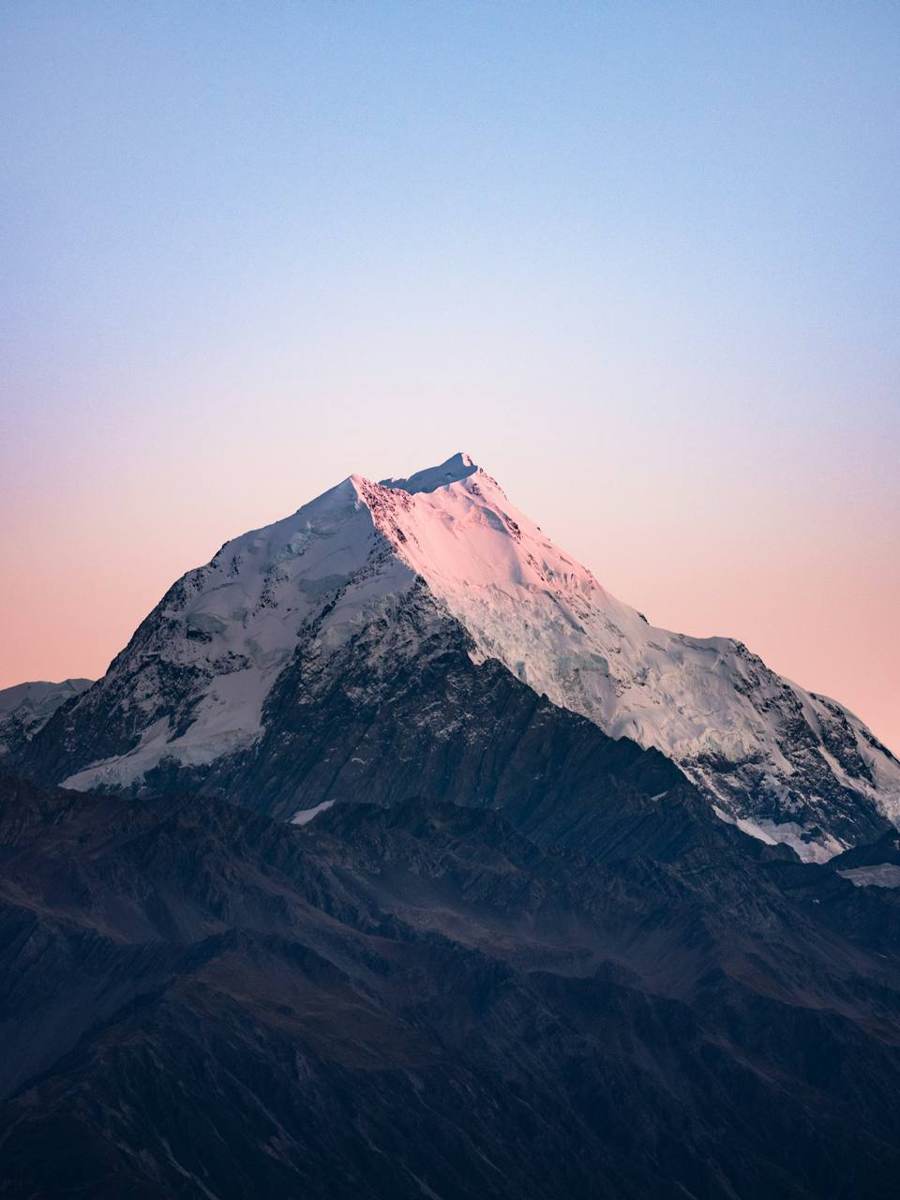
At the top of Mount Everest, nearly nine kilometres above sea level, climbers walk over limestone full of fossils of sea creatures. The rock at the roof of the world was once the floor of an ancient ocean.
It got up there because the continents move. India has been travelling north and crashing into Asia for about 50 million years, crumpling the rock between them into the Himalaya. It is still pushing, a few centimetres a year. The mountains we think of as the very picture of permanence are, on the time-scale of the Earth, waves in slow motion.
“Do they not look at the camels, how they were created? And at the sky, how it was raised? And at the mountains, how they were set firm? And at the earth, how it was spread out?”
Qur'an 88:17-20 · our rendering
These four short verses from Surah al-Ghashiyah ask the first listeners, desert Arabs, to look at the four things always in front of them: their camels, the sky, the mountains and the land. The question is simple and repeated: how? It is an invitation to look closely at familiar things until they become strange and wonderful again.
What science shows
The Earth's outer shell is broken into about a dozen large plates, and many smaller ones, that float on hotter, softer rock beneath. They move at between about 2 and 10 centimetres a year, roughly the speed your fingernails grow. In 1912 the German scientist Alfred Wegener proposed that the continents had once been joined in a supercontinent he called Pangaea. Most geologists rejected the idea for decades, because he could not say what moved them.
The answer came from the sea floor. In the 1950s and 1960s, mapping of the ocean bed, partly by the American geologist and cartographer Marie Tharp, revealed a vast mid-ocean ridge running round the planet. Harry Hess proposed that new sea floor forms there and spreads outwards. In 1963 Fred Vine and Drummond Matthews at Cambridge showed magnetic 'stripes' in the rock either side of the ridge, a record of the Earth's flipping magnetic field. By the late 1960s plate tectonics had become the framework of all geology.
Mountains form where plates collide. When an ocean plate meets a continent, it dives beneath it, making volcanoes and ranges like the Andes. When two continents meet, neither sinks easily, so the crust crumples upward, as in the Himalaya and the Alps. China and Nepal jointly measured Everest in 2020 at 8,848.86 metres.
Mountains also have roots. The crust under high ranges is much thicker than elsewhere, around 70 kilometres under parts of Tibet compared with about 35 kilometres under most continents. Geologists call the balance 'isostasy': mountains float on the denser mantle a little like icebergs, with much of their bulk hidden below. In the 1850s George Airy proposed this to explain why the Himalaya pulled a plumb-line less than expected.
Plate movement is why we have earthquakes and volcanoes, and why the ocean floor is never older than about 200 million years: old sea floor is recycled back into the mantle. It is also part of why Earth is so habitable. Over millions of years, tectonics cycles carbon between rocks, oceans and air, helping keep the climate within a range where liquid water and life can persist.
Britain is a museum of moving plates. The rocks of Scotland and England were once on different continents, separated by an ancient ocean called Iapetus, and joined about 420 million years ago. The Scottish Highlands are the worn-down stumps of a mountain chain once perhaps as high as the Himalaya.
What each faith says
Judaism
“For the mountains may depart, and the hills be removed; but My kindness shall not depart from thee, neither shall My covenant of peace be removed, saith the LORD that hath compassion on thee.”
Isaiah 54:10 · JPS 1917
Mountains are holy places in the Hebrew Bible: Sinai, where the Torah was given; Moriah, where tradition places the Temple; Carmel, where Elijah (peace be upon him) prayed. The psalmist lifts his eyes to the hills and remembers that his help comes not from them but from 'the LORD, who made heaven and earth' (Psalm 121:1-2).
The Mishnah (Berakhot 9:2) teaches a blessing for seeing great mountains, deserts and seas: 'Blessed are You... who makes the work of creation'. The prophet Isaiah (peace be upon him) uses moving mountains as a picture of God's faithfulness, which is steadier even than the hills.
Christianity
“He said to them, “Because of your unbelief. For most certainly I tell you, if you have faith as a grain of mustard seed, you will tell this mountain, ‘Move from here to there,’ and it will move; and nothing will be impossible for you.”
Matthew 17:20 · WEB
In the Gospels, many key moments in the life of Jesus (peace be upon him) happen on mountains: the Sermon on the Mount, the Transfiguration, his prayer on the Mount of Olives. He told his followers that faith 'as a grain of mustard seed' could say to a mountain, 'Move from here to there', and it would move (Matthew 17:20).
Nicolas Steno (1638 to 1686), a Danish scientist who became a Catholic bishop, laid down the basic principles of reading rock layers in 1669: that lower layers are usually older, and that tilted layers were once flat. He is often called a founder of geology, and was beatified by Pope John Paul II in 1988.
Islam
“Have We not made the earth a resting place, and the mountains as pegs?”
Qur'an 78:6-7 · our rendering
The Qur'an describes the mountains as 'pegs' (78:7) and as set firm so that the earth does not sway with people (16:15). Classical commentators read the image as that of a tent held steady by its pegs. Some modern writers link it to mountain roots and claim it as a scientific prediction. We do not: the verse speaks of stability and God's care, and geology has its own evidence. The Qur'an also says the mountains will one day be 'like carded wool' (101:5), and that 'you see the mountains and think them firm, yet they pass by as clouds pass' (27:88), which commentators have mostly read as describing the Day of Judgement.
The Muslim polymath Ibn Sina (980 to 1037), in his Book of Healing, suggested that mountains form through uplift of the ground and through erosion by wind and water over very long periods, and noted fossils in rock. Historians of geology often cite his account as remarkably far-sighted.
Same and different
All three faiths treat mountains as places of revelation and prayer, and all three use them as pictures of what is solid and what will pass. Each tradition has a scripture saying that mountains can move or pass away while God remains. None of the scriptures is a geology textbook, and believers in all three accept the evidence for plate tectonics.
A moment to reflect
- The highest mountain on Earth is made of old sea floor. What does that say to you about change?
- Isaiah says mountains may move but God's kindness will not. What in your life feels as solid as a mountain?
- Why do you think so many religious stories happen on mountains?
- If the ground beneath you is moving, why does it feel so still?
Watch
TED-Ed on why Everest is so tall, and how plates built it.
MinuteEarth explains plate tectonics in under three minutes.
PBS Eons on the supercontinents that formed and broke apart over billions of years.
Snow leopards in the high mountains, from BBC Planet Earth II.
Do it together
Cut out the continents from a printed world map and fit South America against Africa, as Wegener did. Then look up which rock types and fossils match across the gap.
Organise a local hill walk with neighbours of different faiths. At the top, take turns to read Psalm 121, Matthew 17:20 and Qur'an 88:17-20, and say the Jewish blessing for great sights of nature.
Visit a fossil coast such as the Jurassic Coast in Dorset or Robin Hood's Bay in Yorkshire (check tide times and follow safety advice). Find sea creatures turned to stone and talk about how land and sea change places.
Go deeper
- Understanding plate motions (USGS, This Dynamic Earth) · article
- Discovering geology (British Geological Survey) · article
- Marie Tharp (Britannica) · article
- Surah al-Ghashiyah 88 (Quran.com) · scripture
- Psalm 121 (Sefaria) · scripture
Sources (11)
- Marine fossils in limestone at the summit of Everest: Britannica, Mount Everest geology
- India-Asia collision about 50 million years ago; continuing convergence: USGS, The Himalayas: two continents collide
- Plates move at about 2-10 cm per year: USGS, Understanding plate motions
- Wegener's continental drift and Pangaea (1912): USGS, Historical perspective
- Seafloor spreading, Hess; Vine-Matthews magnetic stripes (1963): USGS, Developing the theory
- Everest height 8,848.86 m (2020 China-Nepal survey): Britannica, Mount Everest (2020 China-Nepal survey)
- Crust about 70 km thick under Tibet; isostasy and Airy: Britannica, isostasy
- Ocean floor no older than about 200 million years: Müller et al., Geochemistry, Geophysics, Geosystems 9 (2008)
- Iapetus Ocean closed about 420 million years ago, joining Scotland and England: Britannica, Iapetus Ocean
- Steno's principles of stratigraphy (1669), beatified 1988: Britannica, Nicolas Steno
- Ibn Sina on mountain formation by uplift and erosion: Britannica, Avicenna