A mantis shrimp's eyes can detect ultraviolet and polarised light that is invisible to us. Bees see patterns on flowers, 'landing strips' of ultraviolet, that we cannot see at all.
Most of what is in front of us, we never see. aẓ-Ẓāhir, the Manifest, names the One who is evident everywhere, and is hidden, as al-Ghazālī said, by the very brightness of His showing.
Start with what we know
Then take away everything it needs. What is left is not a bigger version of us. It is the Name.
Episode 1
In us
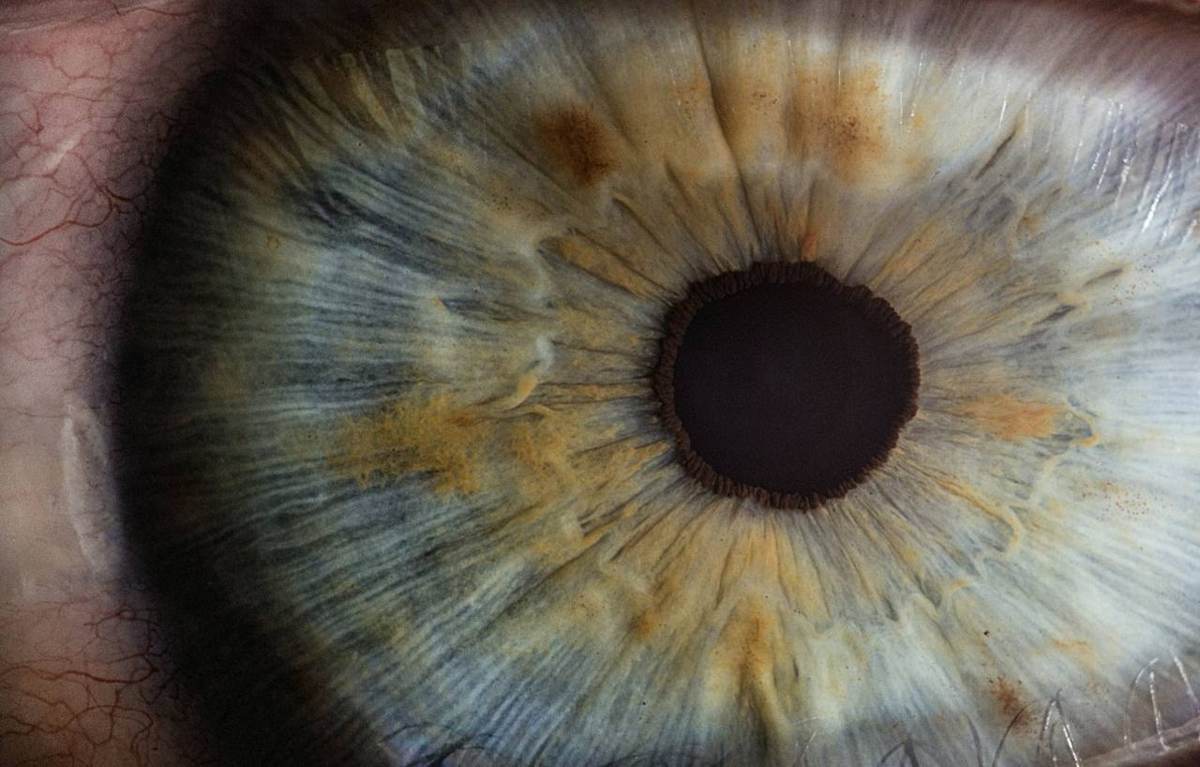
Human eyes see light with wavelengths from about 380 to 700 billionths of a metre: violet through to red. That is a tiny slice of the electromagnetic spectrum, which runs from radio waves kilometres long to gamma rays smaller than an atom. Radio signals, mobile phone data, the warmth of a friend's hand in infrared and the ultraviolet that burns our skin are all around us, and all invisible. We see a thin band and take it for the whole. Most of reality, even the reality right in front of us, is hidden from our eyes.
Episode 2
In nature
Mantis shrimps have some of the most complex eyes in the animal kingdom, with many more kinds of colour receptor than our three, including ones for ultraviolet and polarised light. Bees see ultraviolet too, and many flowers have UV 'nectar guides' that are invisible to us but bright to them. Pit vipers sense the heat of their prey. Every animal lives in its own visible world. But each sees only its own band. No eye in nature sees everything at once.
Episode 3
At our best
Astronomers now look at the sky in every kind of light. Radio dishes, X-ray satellites and the infrared James Webb Space Telescope each reveal a different universe: cold dust, blazing hot gas, the first galaxies whose light has been stretched into infrared by the expansion of space. NASA calls this multiwavelength astronomy. It has shown us more than any generation has ever seen. Yet every instrument reveals one layer and hides the others, and still needs an observer to look.
Episode 4
The Break
Take away the viewer, the wavelength, the instrument and the medium. Every way we see is partial: one band, one layer, one creature's eyes. aẓ-Ẓāhir is not hidden by distance. al-Ghazālī wrote that He is hidden, though manifest, because of the intensity of His manifestness: like daylight, so present it is overlooked. The Qur'an promises signs on every horizon: “We will show them Our signs on the horizons and within themselves until it becomes clear to them that this is the truth” (Qur'an 41:53, our rendering).
Read: 57:3. Muslim 2713a: 'Thou art Evident and there is nothing above Thee'.
From the tradition: Ghazālī (al-Maqṣad): 'He is hidden, though manifest, because of the intensity of His manifestness'; His light is the veil of His light.
On screen
The Sphere is still a shape. aẓ-Ẓāhir is not a bigger shape in a higher world.
The Qur'an tells how the young Abraham (peace be upon him) searched for his Lord among a people who worshipped the stars.
When night came over him, he saw a bright star and said: this is my Lord. But when it set, he said: I do not love things that set.
Then he saw the Moon rising and said: this is my Lord. When it too set, he said: unless my Lord guides me, I will be one of those who go astray.
Then he saw the Sun rising, the biggest and brightest of all, and said: this is my Lord; this is greater. When it set, he turned to his people: I am free of what you set up beside God.
And he said: I have turned my face, sincerely, to the One who created the heavens and the earth. (Qur'an 6:75-79)
Commentators debate whether Abraham (peace be upon him) was searching or teaching his people by stages. Either way, the story turns on the thing that sets. Every light he saw appeared and then disappeared. The One he turned to does not rise and set; He is manifest in all of them, and behind them all. The site's page The lights that set explores the story in full.
What each faith says
Judaism
“How manifold are Thy works, O LORD! In wisdom hast Thou made them all; The earth is full of Thy creatures.”
The Psalms find God made visible in creation. Psalm 104, a great nature poem, moves through springs, birds, wild goats, lions, the moon and the sea, and marvels that every one of these works was made in wisdom.
Jewish tradition also tells of Abraham (peace be upon him) discovering God by looking at the world. In the midrash Genesis Rabbah 39:1, he is compared to a traveller who sees a palace lit up and asks, can it be that it has no owner?
Christianity
“For the invisible things of him since the creation of the world are clearly seen, being perceived through the things that are made, even his everlasting power and divinity; that they may be without excuse.”
Paul wrote to the Christians in Rome that God's invisible qualities, his eternal power and divine nature, “are clearly seen, being perceived through the things that are made”.
Many Christian writers, such as Thomas Aquinas, spoke of 'natural theology': knowing something of God through the world, alongside what Christians believe God has revealed in Scripture and in Christ.
Islam
“On the earth are signs for those with certainty, and in yourselves too. Do you not see?”
aẓ-Ẓāhir appears once, in 57:3, together with al-Bāṭin, the Hidden. The Prophet's bedtime prayer explains the pair: You are the Manifest, and there is nothing above You; You are the Hidden, and there is nothing beyond You (Muslim 2713).
The Qur'an repeatedly calls the things of creation āyāt, signs, the same word used for its own verses. “On the earth are signs for those with certainty, and in yourselves. Do you not see?” (51:20-21).
Same and different
All three faiths see creation as a place where God can be glimpsed: Psalm 104, Romans 1 and the Qur'an's signs. All three also say God is greater than anything seen. Christians add that God has been made visible in Christ, which Jews and Muslims do not accept.
A moment to reflect
What is something you look at every day but rarely notice?
Why might something very obvious be the hardest thing to see?
If you could see one kind of invisible light, which would you choose?
Watch
Watch on YouTube ↗ · plays here on the live site; YouTube without tracking until you press play
Science Magazine on what the mantis shrimp actually sees with its extraordinary eyes.
Watch on YouTube ↗ · plays here on the live site; YouTube without tracking until you press play
NASA Goddard on multiwavelength astronomy: the universe in every kind of light.
Watch on YouTube ↗ · plays here on the live site; YouTube without tracking until you press play
Be Smart on how bees see ultraviolet patterns on flowers.
Do it together
schools / familiesInvisible light
Point a TV remote at a phone camera and press a button: the phone sees the infrared flash that your eyes cannot. Talk about what else might be there that we cannot see.
faith groups / neighboursThe lights that set
Watch a sunset together and then the stars come out. Read Qur'an 6:75-79 and the Genesis Rabbah palace story, and share what helps each person notice God.

 Episode 1