In 2025 the Saudi statistics authority counted 1,673,230 pilgrims at the Hajj, and in 2026, 1,707,301: men and women from almost every country on Earth, dressed alike, standing on one plain.
Gathering people takes years of planning. Gathering stars takes millions of years of gravity. al-Jāmiʿ, the Gatherer, gathers everything, and everyone, by will.
Start with what we know
Then take away everything it needs. What is left is not a bigger version of us. It is the Name.
Episode 1
In us
The Hajj is one of the largest regular gatherings of people anywhere. According to Saudi Arabia's General Authority for Statistics, 1,707,301 people performed it in 2026. Pilgrims from Indonesia, Nigeria, Britain and Bosnia wear the same simple white cloth and stand together at ʿArafāt. It takes years of saving for many families, visas, flights, tents, water, medical teams and hundreds of thousands of workers. It is a triumph of human organisation. But every gathering we arrange needs planning, money and logistics, and it ends when people go home.
Episode 2
In nature
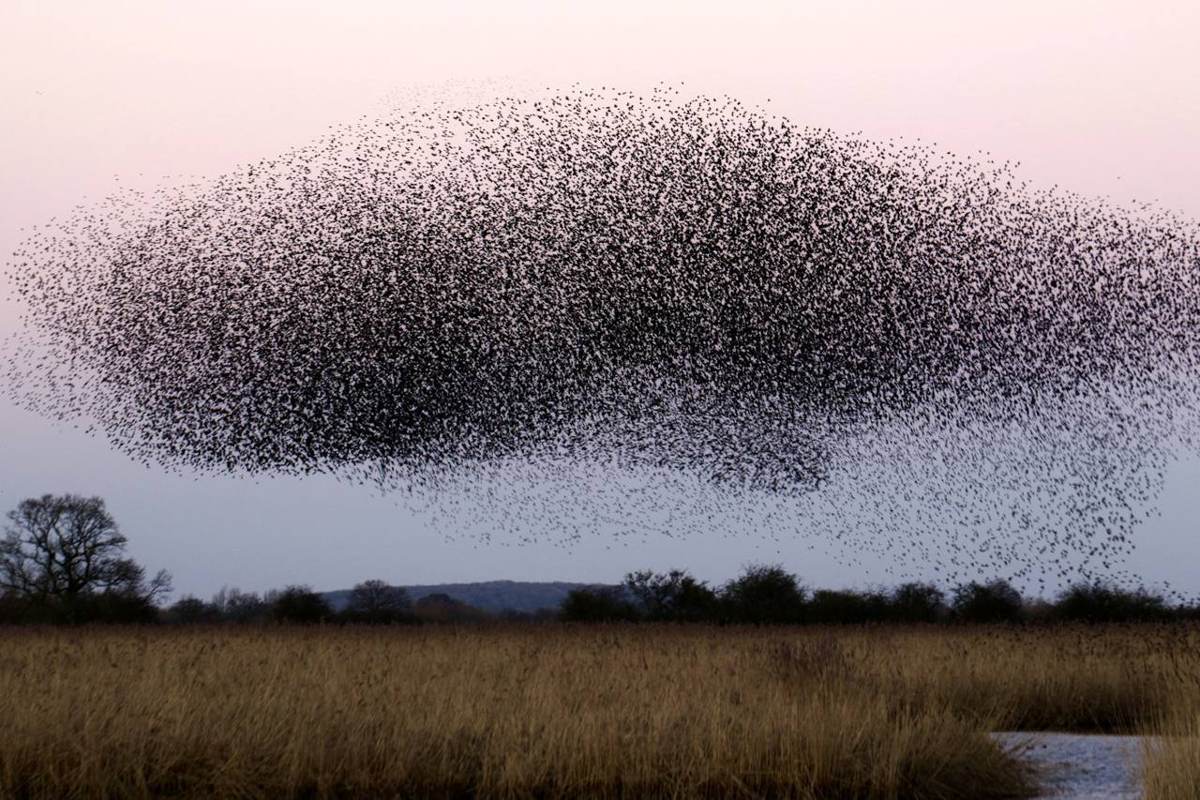
On winter evenings across Britain, flocks of starlings swirl into vast shape-shifting murmurations before roosting. In 2008 Michele Ballerini and colleagues, filming starlings over Rome, found in PNAS that each bird keeps track of only about six or seven of its nearest neighbours, not the whole flock. From those small connections, a single moving shape of tens of thousands of birds appears. It is one of nature's most beautiful gatherings. But it lasts minutes, and it scatters at dawn.
Episode 3
At our best
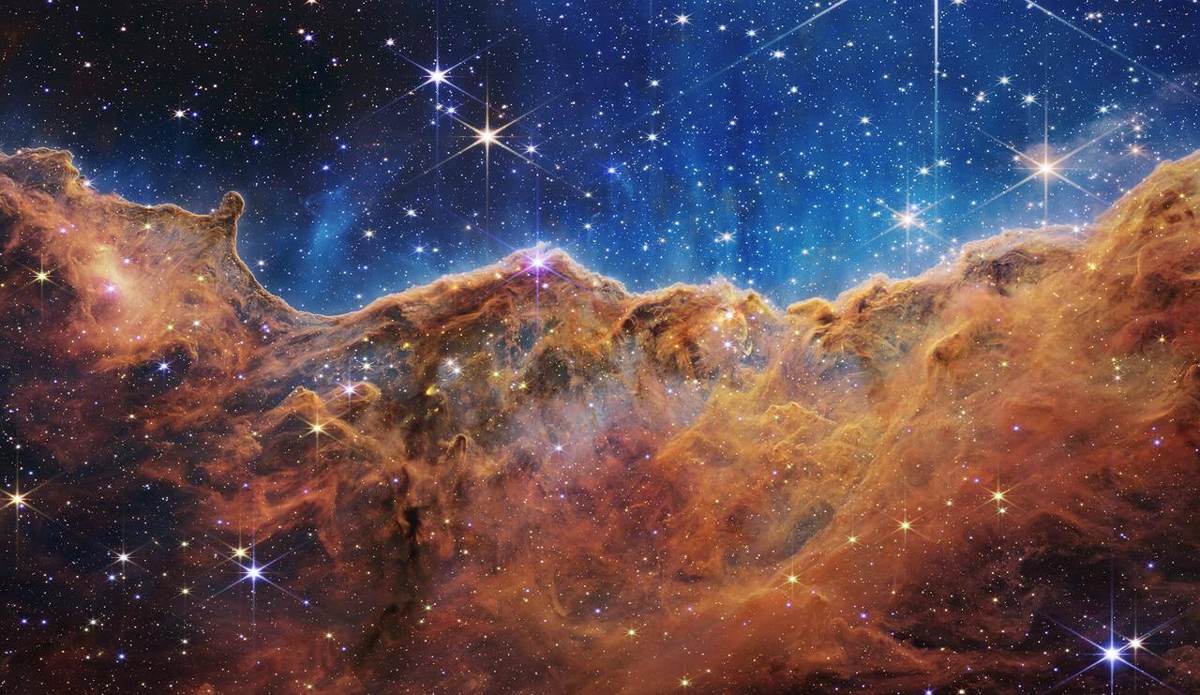
Gravity is the weakest of the four fundamental forces, CERN explains, but it has an infinite range. Over millions of years it pulls thin clouds of gas and dust together until they collapse into stars, as in the Pillars of Creation photographed by Hubble and Webb. Every star in the sky was gathered this way. We understand it well enough to simulate it on supercomputers. Yet gathering by force is slow and blind: it takes millions of years, and it gathers only what is near enough to fall.
Episode 4
The Break
Take away force, time, logistics, and the scattering that always follows. Every gathering we know is held together by something, for a while: gravity, a flock's rules, a timetable. al-Jāmiʿ gathers likes and unlikes, al-Ghazālī said, and even opposites. He gathers people on one Day, and gathers the scattered parts of every heart. “Our Lord, You will gather people together for a Day of which there is no doubt; God does not break His promise” (Qur'an 3:9, our rendering).
The Qur'an tells that when Abraham (peace be upon him) and his son Ishmael (peace be upon him) had raised the foundations of the House at Mecca, God told Abraham (peace be upon him): “Proclaim the pilgrimage to people. They will come to you on foot, and on every lean camel, from every deep and distant pass” (Qur'an 22:27).
Classical commentators, such as Ibn Kathīr, report from Ibn ʿAbbās a moving detail. Abraham (peace be upon him) said: Lord, how can my voice reach people? He was standing in a barren valley with hardly anyone in it. He was told: you call, and We will make it reach. So he stood and called, and the tradition says his call was carried to everyone who would ever answer it.
More than four thousand years later, by the traditional reckoning, the pilgrims still answer. As they arrive they say: labbayk Allāhumma labbayk, “Here I am, O God, here I am.”
In his Farewell Pilgrimage, the Prophet Muhammad (peace be upon him) reminded that vast crowd that no Arab is better than a non-Arab, and no non-Arab than an Arab, except in goodness (Musnad Aḥmad 23489). The gathering itself was the lesson: one Lord, one human family.
What each faith says
Judaism
“A Song of Ascents; of David (peace be upon him). Behold, how good and how pleasant it is For brethren to dwell together in unity!”
The Torah promises a scattered people that God will gather them again: “the LORD thy God will... return and gather thee from all the peoples, whither the LORD thy God hath scattered thee.” The hope of the ingathering, kibbutz galuyot, is in the daily Amidah.
Psalm 133, sung at many Jewish gatherings, celebrates the joy of being together: “Behold, how good and how pleasant it is for brethren to dwell together in unity.”
Christianity
“a great multitude, which no man could count, out of every nation and of all tribes, peoples, and languages”
The Book of Revelation pictures a great gathering before God: “a great multitude, which no man could count, out of every nation and of all tribes, peoples, and languages”.
Christians believe God's purpose is to gather all things together in Christ (Ephesians 1:10), a distinctively Christian hope. Many churches in Britain today are among the most ethnically mixed gatherings in their towns.
Islam
“People, We created you from a male and a female, and made you nations and tribes so that you may come to know one another. The noblest of you in God's sight is the most mindful of Him.”
al-Jāmiʿ appears in the Qur'an in prayers like 3:9 and in 4:140. The Qur'an explains why God made people different and then brings them together: “People, We created you from a male and a female, and made you nations and tribes so that you may come to know one another” (49:13).
Muslims gather five times a day in rows, weekly at Friday prayer, yearly at the two Eids, and once in a lifetime, if they can, at the Hajj.
Same and different
Psalm 133, Revelation's great multitude and the Hajj all celebrate many peoples gathered before one God. All three faiths gather weekly and on festivals. They differ in what they hope the final gathering will be around: for Christians, Christ; for Jews, the restoration of Israel and the nations; for Muslims, the Day of Judgement before God.
A moment to reflect
What is the biggest gathering you have ever been part of? How did it feel?
Why do you think the Qur'an says we were made different 'so that you may come to know one another'?
Who is missing from the gatherings in your neighbourhood?
Watch
Watch on YouTube ↗ · plays here on the live site; YouTube without tracking until you press play
BBC's Life in the Air on how starlings flock without crashing into each other.
Watch on YouTube ↗ · plays here on the live site; YouTube without tracking until you press play
The British Museum's film on the Hajj, the journey to the heart of Islam.
Do it together
families / neighboursStarling evening
Between November and February, find out where starlings roost near you (the RSPB lists sites) and go together at dusk. Count how long the murmuration lasts.
faith groupsOpen doors
Arrange a visit to each other's places of worship on a festival day: an Eid prayer, a Shabbat service, a Sunday service. Read Psalm 133:1, Revelation 7:9 and Qur'an 49:13 together.

 Episode 1