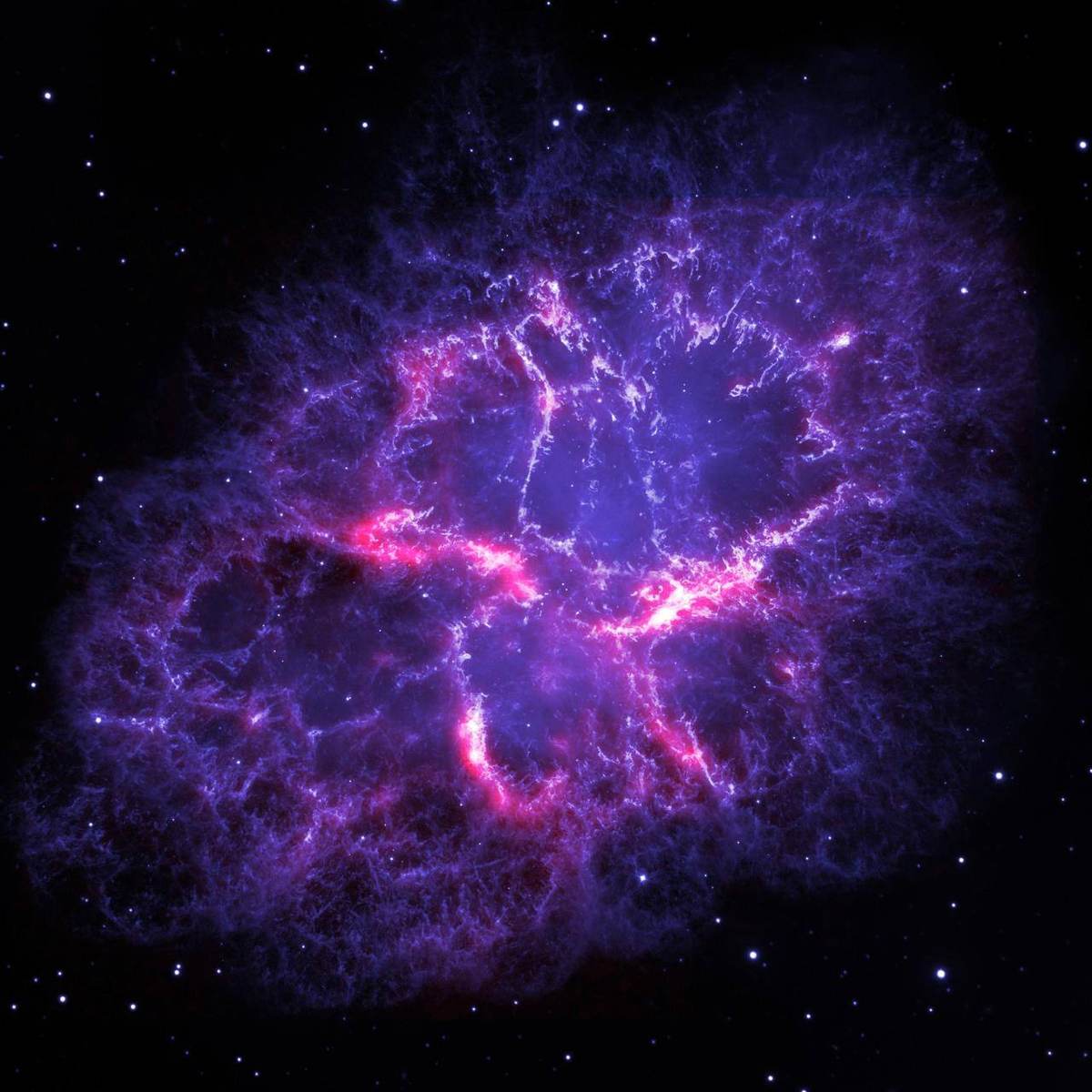
In 1868 astronomers studying the Sun during an eclipse saw a yellow line of light that matched no known element. They called the mystery element helium, after the Greek for Sun. It was not found on Earth until 1895.
The same atoms, giving the same lines of light, from our labs to the most distant galaxies. Everything we call 'one' turns out to be one of many. al-Wāḥid is One with no second at all.
Start with what we know
Then take away everything it needs. What is left is not a bigger version of us. It is the Name.
Episode 1
In us
You are one person in about 8.2 billion alive today, according to United Nations estimates. Your fingerprints, your voice and your story are unique, and that matters. But even your uniqueness is a kind of 'one among many': one person in a family, one family in a street, one species among millions. Human beings are wonderfully singular and never alone in our kind. Even identical twins, who share almost all their DNA, are two people. Everything about us is 'one' in the way a single brick in a wall is one.
Episode 2
In nature
Every living thing on Earth, from a bacterium to a blue whale, stores its instructions in DNA and reads them with almost exactly the same genetic code. That shared code is one of the strongest pieces of evidence that all life is related, branches of a single tree. It is one of the most beautiful unities in nature. But it is the unity of a family, not of one being: millions of species, each one of a kind among relatives. In nature, 'one' always means one of many.
Episode 3
At our best
Spectroscopy splits light into its colours. Each element leaves its own pattern of bright or dark lines, like a barcode. When astronomers looked at the Sun, the stars and galaxies billions of light years away, they found the same barcodes: the same hydrogen, the same sodium, the same physics everywhere. In 1868 one unknown line in sunlight even revealed helium before it was found on Earth. The universe is astonishingly consistent. But a unity of pattern is not the One. It tells us the universe is orderly; it does not count God.
Episode 4
The Break
Take away the 'one of many', the rival, the family of relatives, the second that every first implies. Everything we call one is one of a kind among others, or one pattern repeated in many places. al-Wāḥid is not the last one left standing, or the biggest in a set. He is One with no set at all. This is wonder, not proof: the consistency of nature is a sign to think about, not an argument that does the thinking for us. “Say: God is the Creator of all things, and He is the One, the All-Prevailing” (Qur'an 13:16, our rendering).
Joseph (peace be upon him), sold by his brothers and falsely accused, ended up in an Egyptian prison. Two other men were thrown in with him: one had served wine at the king's table, the other had baked his bread. Each had a strange dream and asked Joseph (peace be upon him) what it meant, because they could see he was a good man.
Before he explained their dreams, Joseph (peace be upon him) spoke to them about God. He told them that he had left the religion of people who did not believe, and followed the way of his fathers, Abraham (peace be upon him), Isaac (peace be upon him) and Jacob (peace be upon him).
Then he asked them a question: “My two fellow prisoners, are many different lords better, or God, the One, the All-Prevailing?” (Qur'an 12:39). He explained that the names they worshipped were only names their fathers had made up.
After that he interpreted their dreams. One would serve the king again. The other would not live. (Qur'an 12:36-41)
The Torah tells the same prison scene in Genesis 40, with the cupbearer and the baker and their dreams, and Joseph (peace be upon him) saying, “Do not interpretations belong to God?” In both tellings, a prisoner with nothing points to the One.
What each faith says
Judaism
“HEAR, O ISRAEL: THE LORD OUR GOD, THE LORD IS ONE.”
The central sentence of Judaism is the Shema: “Hear, O Israel: the LORD our God, the LORD is One” (Deuteronomy 6:4). Jews say it morning and evening, and many hope it will be their last words. The Talmud tells how Rabbi Akiva, executed by the Romans, died saying the word eḥad, One (Berakhot 61b).
Maimonides' second principle of faith is that God is one, with a oneness unlike any other: not one of a pair, nor one like a body that has parts.
Christianity
“Jesus (peace be upon him) answered, “The greatest is, ‘Hear, Israel, the Lord our God, the Lord is one:”
Asked which commandment was the greatest, Jesus (peace be upon him) answered by quoting the Shema: “Hear, Israel, the Lord our God, the Lord is one.” Christians are monotheists and say so in their creeds: “We believe in one God”.
Christians also believe that the one God is Father, Son and Holy Spirit, three persons in one being: the Trinity. They understand this as a statement about the inner life of the one God, not three gods. Muslims and Jews do not accept the Trinity, and this is one of the real differences between the faiths.
Islam
“Glory be to Him. He is God, the One, the All-Prevailing.”
al-Wāḥid occurs many times in the Qur'an, often with al-Qahhār, the All-Prevailing: “To whom does the kingdom belong this Day? To God, the One, the All-Prevailing” (40:16). Tawḥīd, the oneness of God, is the foundation of Islam.
The Ashʿarī theologians described God as one in His essence, in His attributes and in His acts: nothing shares His being, nothing is like His qualities, and nothing acts beside Him.
Same and different
The Shema, the creed and the Shahāda all begin with one God, and Jesus (peace be upon him) quoted the Shema himself. All three faiths reject many gods. The real difference is the Trinity: Christians believe the one God is three persons; Jews and Muslims believe God's oneness rules that out. Each describes its belief in its own words.
A moment to reflect
In what ways are you 'one of a kind', and in what ways are you 'one of many'?
Why do you think the prisoners' question in Joseph (peace be upon him)'s story still matters?
What changes, if anything, when you think of the whole universe following the same laws?
Watch
Watch on YouTube ↗ · plays here on the live site; YouTube without tracking until you press play
Brian Cox shows how splitting starlight reveals the same elements across the universe.
Watch on YouTube ↗ · plays here on the live site; YouTube without tracking until you press play
Thousands of starlings move as one shape: unity in many, filmed by National Geographic.
Do it together
schools / familiesRainbow barcodes
Use a cheap diffraction grating or an old CD to look at a street light, a candle and a bulb. Each shows a different pattern. Talk about how astronomers read starlight the same way.
faith groups / schoolsThree ways of saying One
Learn the Shema, the opening of the Nicene Creed and Sūrat al-Ikhlāṣ, each from someone of that faith. Notice what they share and listen carefully to how each explains its differences.
 Episode 1