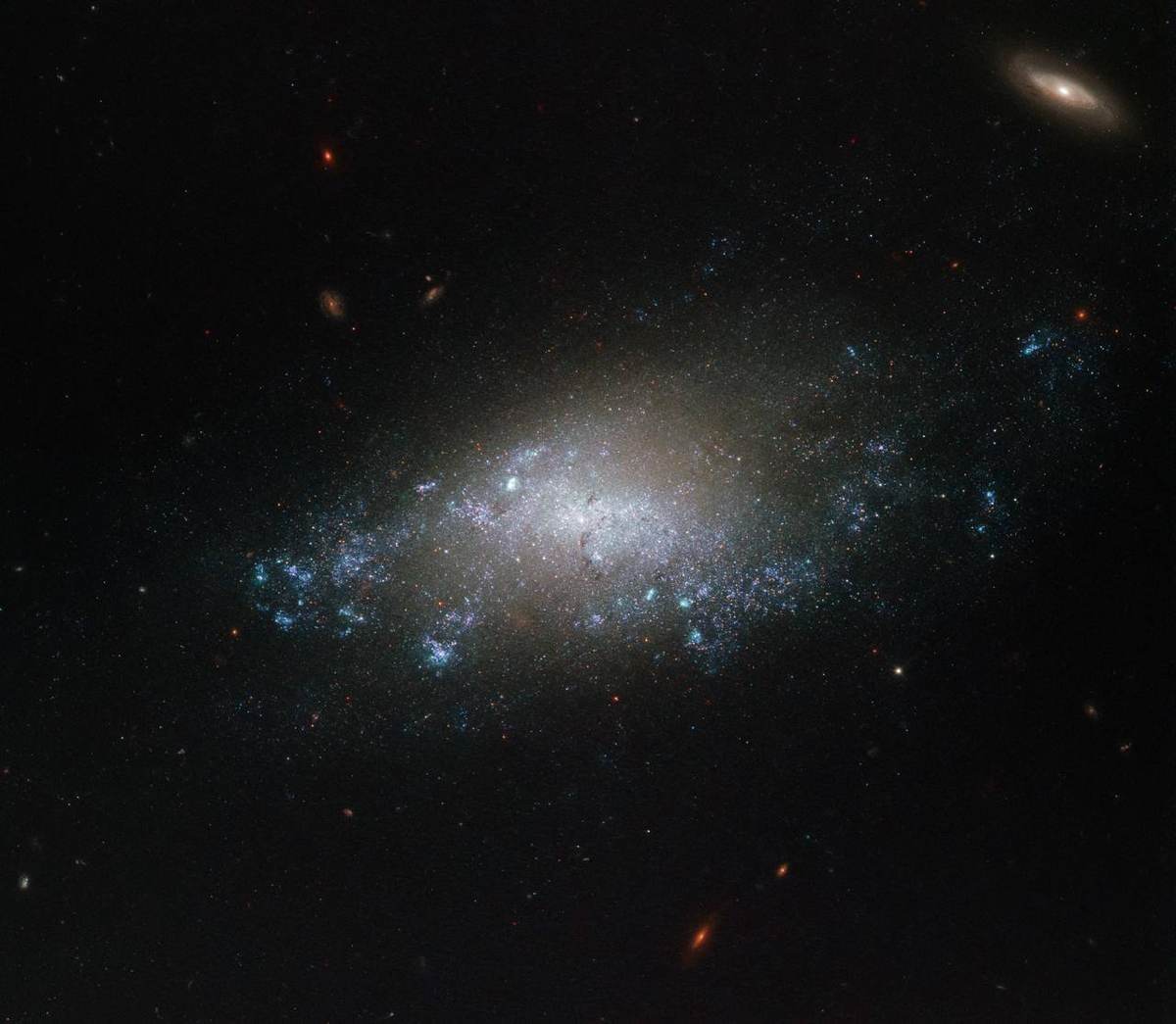
In December 1995 the Hubble Space Telescope stared at a patch of sky smaller than a grain of sand held at arm's length, for ten days. When the images were combined, almost every speck turned out to be a galaxy: about 3,000 of them.
Glory is everywhere once you look. al-Mājid, the Noble and Glorious, names a glory that is not given by anyone and never fades.
Start with what we know
Then take away everything it needs. What is left is not a bigger version of us. It is the Name.
Episode 1
In us
Human glory is given by others. Twice a year the UK publishes its honours lists, with more than a thousand names each time: knighthoods, MBEs, medals for bravery and service. People queue at the palace in their best clothes, and rightly feel proud. But every honour depends on someone who grants it, and almost all are forgotten within a generation. Honours can even be taken away: forfeiture rules allow them to be removed if someone brings the system into disrepute. Our glory is real, and borrowed, and it fades.
Episode 2
In nature
In the forests of New Guinea, male birds-of-paradise turn themselves into living works of art. Some fan out velvet-black capes edged with electric blue; others hang upside down in a burst of gold plumes, dancing for a watching female. The displays, filmed for series such as Our Planet and Planet Earth, are among the most dazzling sights in nature. Yet every display needs an audience, lasts a season, and has a purpose: to be chosen. Nature's glory is spectacular and short-lived.
Episode 3
At our best
The Hubble Deep Field of 1995, and Webb's even deeper images since 2022, changed how people picture the universe. A tiny dark patch turned out to hold thousands of galaxies, each with billions of stars. The images have been printed on posters, stamps and phone screens around the world. They are among the most glorious things humans have ever seen. And still they are pictures of glory, not glory itself: light that left those galaxies billions of years ago, caught for a moment, shared, and then, for most of us, scrolled past.
Episode 4
The Break
Take away the giver of honours, the watching audience, the season, the fading. Every glory we know is given to someone, or seen by someone, for a time. al-Mājid's glory is not given to Him; it gives. al-Ghazālī described the Name as glory joined to generosity: majesty that overflows in gifts. The angels said it to Abraham (peace be upon him)'s household: “God's mercy and His blessings be upon you, people of this house. He is Praiseworthy, Glorious” (Qur'an 11:73, our rendering).
Read: 85:15; al-Majīd (11:73); al-Mājid not verbatim.
From the tradition: Ghazālī: al-Mājid as al-Majīd, glory with lavish giving.
Kavod (glory), Ps 19:2 'The heavens declare the glory of God'. Weak-moderate.
In the universe
Webb deep field.
In nature
Birds-of-paradise (Our Planet 'Jungles').
In people
Anonymous donors.
In science
Optics: dispersion of light by a prism.
Living it
Generosity that seeks no honour.
Its kind
Beyond: majesty: what He is not, and how far beyond.
In the Qur'an: none (cf. al-Majīd)
Guests at Abraham's tent
Three strangers came to the tent of Abraham (peace be upon him). He hurried to welcome them, as he always did, and brought out a roasted calf. The guests did not eat, and he grew uneasy. They reassured him: do not be afraid. They were messengers, sent with good news.
His wife Sarah (peace be upon her) was standing nearby. When she heard that she, an old woman, would have a son, she laughed. “How can I bear a child,” she said, “when I am old and my husband is an old man? That would be a wonder.”
The messengers answered with a blessing: do you wonder at what God decrees? God's mercy and His blessings be upon you, people of this house. He is Praiseworthy, Glorious, ḥamīdun majīd. (Qur'an 11:69-73)
The Torah tells the same visit, at the oaks of Mamre, with the same laughter and the same question: “Is any thing too hard for the LORD?” (Genesis 18:14). Muslims repeat the angels' words in every prayer, when they ask God to bless Muhammad (peace be upon him) and his family as He blessed Abraham (peace be upon him) and his family: “You are Praiseworthy, Glorious” (Bukhari 3370).
What each faith says
Judaism
“The heavens declare the glory of God, and the firmament showeth His handiwork”
The Hebrew word for glory, kavod, also means weight: something substantial and real. Psalm 19 opens with the whole sky as its witness: “The heavens declare the glory of God”.
In Isaiah's vision the angels call to each other: “Holy, holy, holy, is the LORD of hosts; the whole earth is full of His glory” (Isaiah 6:3). These words are sung in the Kedushah of the synagogue service.
Christianity
“We saw his glory, such glory as of the one and only Son of the Father, full of grace and truth.”
Christians sing the angels' “Glory to God in the highest” at Christmas and in the Gloria at Holy Communion. Isaiah's “Holy, holy, holy” is sung in churches as the Sanctus.
John's Gospel adds a distinctively Christian claim: “We saw his glory,” it says of Jesus (peace be upon him), “full of grace and truth”. For Christians, God's glory was seen in a person; Jews and Muslims do not share that belief.
al-Mājid is in the traditional list of 99 but not in the Qur'an word for word; the Qur'an uses the closely related al-Majīd, as in 11:73 and “Lord of the Throne, the Glorious” (85:15). Scholars treat the two as one meaning, with al-Mājid emphasising lavish generosity.
Islam teaches that glory belongs to God and that people should be wary of seeking it for themselves; honour comes from God and from good character.
Same and different
Abraham (peace be upon him)'s guests appear in the Torah and the Qur'an, and their blessing is shared ground. Jews sing “Holy, holy, holy” and so do Christians; Muslims bless Abraham's household in every prayer. The difference is where God's glory is said to be seen most fully: in creation and the Torah, in Christ, or in creation and the Qur'an.
A moment to reflect
What is the most glorious thing you have ever seen?
What is the difference between glory and fame?
Why do you think the angels' blessing is about a home and a family?
Watch
Watch on YouTube ↗ · plays here on the live site; YouTube without tracking until you press play
Our Planet's footage of birds-of-paradise: nature's glory in feathers, filmed in New Guinea.
Watch on YouTube ↗ · plays here on the live site; YouTube without tracking until you press play
Fifteen years of Hubble discoveries, including the deep fields full of galaxies.
Do it together
neighbours / faith groupsHospitality like Abraham
Host a simple shared meal and invite someone you do not know well. Read Genesis 18:1-8 and Qur'an 11:69-73 together and talk about welcoming strangers.
schools / familiesGlory in a grain
Print the Hubble Deep Field. Hold a grain of rice at arm's length against the sky to see how small a patch it covers. Count the galaxies in one corner of the picture together.

 Episode 1