In 2020 a team at the Weizmann Institute in Israel weighed everything human beings have ever made: concrete, bricks, metal, plastic, asphalt. Sometime that year, they reported, the total passed about 1.1 trillion tonnes, outweighing all the living things on Earth, every tree, whale and bacterium put together.
We are astonishing makers. But look closely and every single thing we have made was made from something already there. al-Khāliq is the Creator: the One who measures out and brings into being. This episode asks what making would be if there were nothing to make it from.
Start with what we know
Then take away everything it needs. What is left is not a bigger version of us. It is the Name.
Episode 1
In us
The Weizmann team found that human-made mass has been roughly doubling every twenty years, and that in 2020 it overtook the dry weight of all life on the planet (Elhacham and others, Nature, 2020). Every year we now produce more stuff than the weight of every human body alive. It is a staggering measure of human skill. But every gram of it was rearranged, not created. Concrete is crushed limestone and sand; plastic was once oil; steel was once ore in the ground. We are makers who borrow every atom we use.
Episode 2
In nature
In 2007 a researcher looking at satellite images spotted a beaver dam in Wood Buffalo National Park in northern Canada about 850 metres long, the largest ever recorded and visible from space (Parks Canada). Generations of beavers had built it from felled trees, mud and stones, and in doing so they had made a whole wetland where many other creatures now live. Beavers are master engineers of the landscape. But they build only with what the forest gives them, by instinct, and the dam lasts only as long as they keep repairing it.
Episode 3
At our best
In 2016 scientists at the J. Craig Venter Institute in California announced JCVI-syn3.0, a bacterium with a genome they had designed and built in the lab, cut down to just 473 genes, the smallest of any free-living cell (Hutchison and others, Science, 2016). It is one of biology's great achievements. Yet the synthetic genome had to be placed inside an existing cell to come alive, using chemistry and laws of nature that were already there. And the team admitted they did not know what 149 of those 473 genes actually do.
Episode 4
The Break
Take away the limestone and the oil, the felled trees, the host cell, the borrowed laws of chemistry, the trial and error. Every maker we know rearranges what was already given. al-Khāliq is not a better engineer; He is the One who measures out and brings into being, with no material waiting for Him. “He is God, the Creator, the Originator, the Fashioner. His are the most beautiful Names” (Qur'an 59:24, our rendering).
From the tradition: Nahj al-Balāgha Sermon 1: created 'without undergoing reflection, without making use of any experiment'. al-Ghazālī's architect sequence: khalq = planning, determining
On screen
Arishem makes worlds because he needs something from them. al-Khāliq makes, and needs nothing from what He makes (Q 112).
The Qur'an tells of a king who argued with Abraham (peace be upon him) about his Lord. Commentators name the king as Namrūd, or Nimrod, the ruler of Abraham (peace be upon him)'s homeland in Mesopotamia. He had power, armies and wealth, and he believed that gave him the right to be treated as a god.
Abraham (peace be upon him) said: “My Lord is the One who gives life and causes death.”
The king replied: “I give life and cause death.” Commentators explain that he had two prisoners brought out; he executed one and spared the other, as if that made him a giver of life.
So Abraham (peace be upon him) went to something no king can rearrange. “God brings the sun up from the east. So bring it up from the west.” And the one who disbelieved was struck dumb (Qur'an 2:258).
The story is short, and it does not mock the king. It simply shows the difference between power over things that already exist and the power to bring them into being. A ruler can decide who lives in his prison. He cannot make a single sunrise, or a single prisoner. Abraham (peace be upon him)'s argument was not cleverness; it was pointing at the morning.
What each faith says
Judaism
“In the beginning God created the heaven and the earth.”
The Torah opens with creation: “In the beginning God created the heaven and the earth.” The Hebrew verb bara is used in the Bible only of God; people can make (asah) and form (yatzar), but only God creates.
Jewish tradition praises the Creator every morning in the blessing Yotzer Or, “who forms light and creates darkness”, and teaches that God renews the work of creation every day. Isaiah calls Him the Creator of the ends of the earth, who never grows weary.
Christianity
“All things were made through him. Without him was not anything made that has been made.”
The Nicene Creed, said in churches around the world, begins: “We believe in one God, the Father, the Almighty, maker of heaven and earth, of all that is, seen and unseen.” Christian teachers from the early centuries taught creation ‘out of nothing’ (ex nihilo).
Christians also believe that creation came about through the Word, whom they identify with Christ. John's Gospel opens by echoing Genesis.
Islam
“Say: God is the Creator of all things, and He is the One, the Overwhelming.”
al-Khāliq opens the trio of creating Names in Qur'an 59:24: al-Khāliq, al-Bāriʾ, al-Muṣawwir. al-Ghazālī compared them to the work of a builder: first the plan and the measuring out, then the bringing into being, then the giving of form. But he stressed that God needs no material and no tools. The root kh-l-q includes taqdīr, measuring out: creation comes with its proportions already set.
The Qur'an repeatedly invites people to ask where things come from: “Were they created from nothing, or are they the creators?” (52:35). And it challenges anyone who claims to create: let them make even a fly (22:73).
Same and different
Judaism, Christianity and Islam all confess one Creator of heaven and earth, who creates from nothing, needs nothing, and holds creation in being moment by moment. All three use a special word for creating that is not used of human making. They differ in one important place: Christians believe creation came through the Word, the eternal Son, whom they understand as one with the Father; Jews and Muslims hold that God creates directly, with no partner or intermediary.
A moment to reflect
What is the best thing you have ever made, and what did you make it from?
Can you think of anything at all that a person has made from nothing?
If you were made rather than self-made, what does that change about how you see yourself?
Watch
Watch on YouTube ↗ · plays here on the live site; YouTube without tracking until you press play
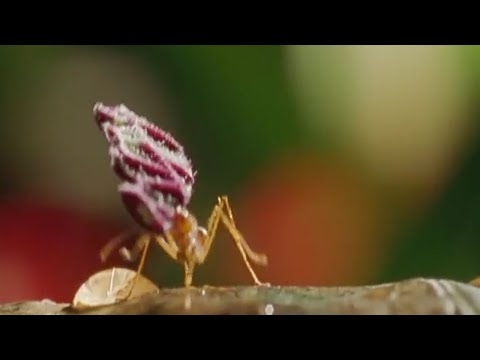
The beaver dam so large it can be seen from space: the ‘In nature’ rung.
Watch on YouTube ↗ · plays here on the live site; YouTube without tracking until you press play
Inside a termite mound with Brian Cox: architecture built from what the earth provides.
Watch on YouTube ↗ · plays here on the live site; YouTube without tracking until you press play
The first synthetic cell announced in 2010, the forerunner of JCVI-syn3.0: the ‘At our best’ rung.
Do it together
schools / familiesFrom what?
Take ten everyday objects (a mug, a pencil, a T-shirt, a phone) and trace each one back to what it was made from, then what that was made from. See how far back you can go before you reach something no person made.
faith groupsCreation in three voices
Read Genesis 1:1-5, John 1:1-5 and Qur'an 59:22-24 aloud, one after the other, in a mixed group. Ask each person to pick out one word that strikes them and say why.
 Episode 1