In February 1985, the South African government offered Nelson Mandela his freedom. He had been in prison for over twenty years. The condition was that he reject violence on their terms. He refused. His daughter Zindzi read his answer to a packed stadium in Soweto: “Only free men can negotiate. Prisoners cannot enter into contracts.”
There is a kind of strength that walls cannot take away. al-ʿAzīz is the Almighty, the One who is never overcome, and the One whose honour no one can take. This episode looks at the strongest things we know, and finds the crack in each.
Start with what we know
Then take away everything it needs. What is left is not a bigger version of us. It is the Name.
Episode 1
In us
Nelson Mandela spent 27 years in prison, 18 of them on Robben Island, breaking rock in a lime quarry whose glare damaged his eyes (Nelson Mandela Foundation). He kept his dignity, his humour and his refusal. When he walked free in February 1990, he went on to lead South Africa away from civil war. Few people have shown such unbreakable strength of spirit. But his body was not unbreakable. He caught tuberculosis in prison in 1988, his eyes never fully recovered, and his release depended on millions of people campaigning outside. Even the strongest human will rests on a body and on others.
Episode 2
In nature
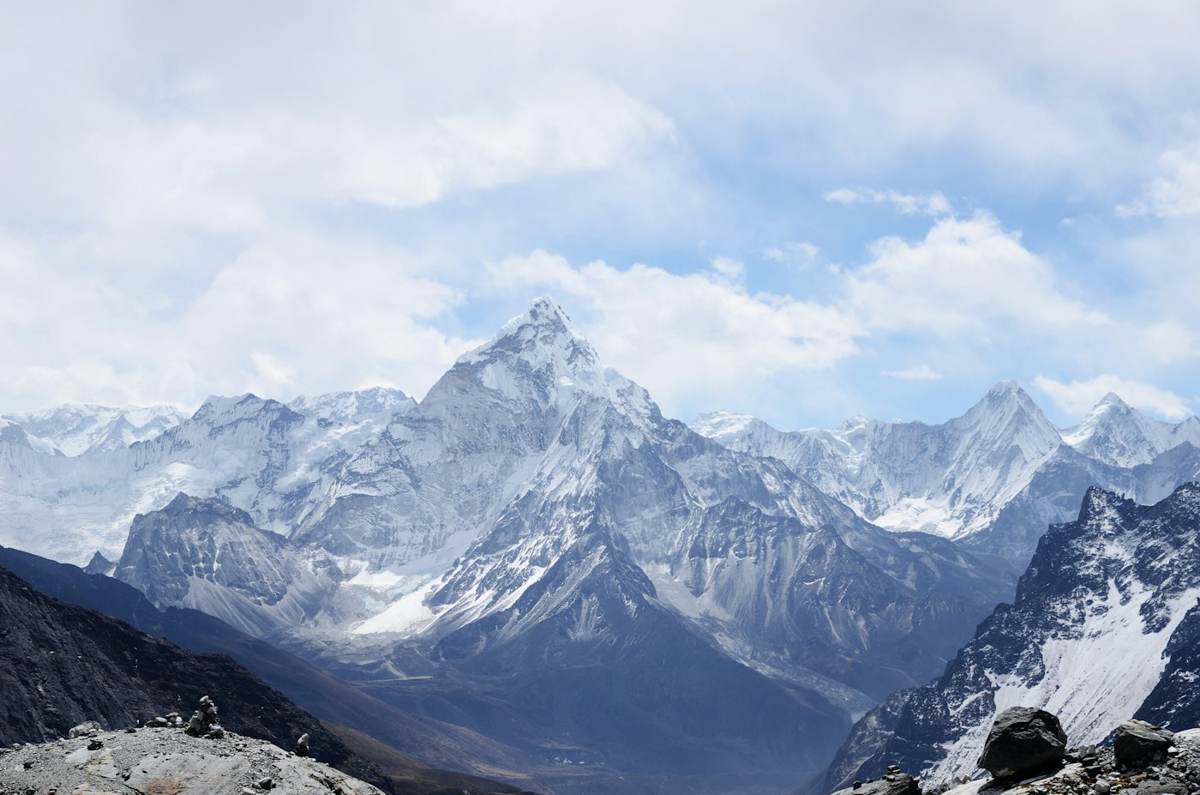
In 2020, Chinese and Nepali surveyors announced Mount Everest's new official height: 8,848.86 metres. It is still growing, because the Indian plate keeps pushing into Asia and lifting the Himalaya by millimetres a year (US Geological Survey). Nothing on land stands taller. Yet the mountain is also being worn away. Ice, wind and rivers grind it down, and the 2015 Nepal earthquake shook its slopes into avalanches. The highest place on Earth is a balance between being raised and being broken down.
Episode 3
At our best
Diamond is the hardest natural material known. It scores 10, the top, on the Mohs scale, and we use it to cut steel, drill through rock and polish other gems (Gemological Institute of America). Yet hardness is not the same as toughness. A diamond has planes in its crystal where its bonds are weaker, and a sharp blow along one of them can split it in two; a jeweller uses exactly that to cleave a stone. Heated in air to around 800 °C, it burns. Our hardest thing has a direction in which it gives.
Episode 4
The Break
Take away the body that tires, the campaigners outside, the slow grinding of ice, the weak plane in the crystal. Everything strong we know has a breaking point somewhere. al-ʿAzīz is not the strongest thing on the list; He is strength with no weak plane and no rival. And the Qur'an almost always pairs this Name with al-Ḥakīm, the Wise: His might is never blind. “Whoever wants honour: all honour belongs to God” (Qur'an 35:10, our rendering).
Read: Q 59:23; 57:1; 63:8 honour belongs to Allah, His Messenger and the believers
From the tradition: al-Ghazālī: al-ʿAzīz is rare, much needed and hard to reach, all three at once. Classical note: the Qur'an most often pairs ʿAzīz with Ḥakīm, so might is usually shown with wisdom; it also pairs it with ar-Raḥīm (26:9), al-Ghaffār (38:66), al-Ḥamīd (85:8) and al-ʿAlīm (6:96)
On screen
Every hero we invent needs a weakness to be interesting. al-ʿAzīz has none, and is most often named beside 'the Wise'.
In about the year 637, the Muslim army reached Jerusalem. The city's patriarch, Sophronius, would only hand over the keys to the caliph himself. So ʿUmar ibn al-Khaṭṭāb, ruler of a growing empire, travelled from Medina to Syria with a single servant and one camel. They took turns riding.
Near the city they came to a ford. ʿUmar got down, took off his leather socks, slung them over his shoulder and led the camel through the water by its rope. His general, Abū ʿUbaydah, was alarmed: the people of the city were watching, and the ruler of the Muslims looked like a camel-driver. “Commander of the Faithful, I would not like these people to see you like this.”
ʿUmar answered: “We were the most humble of people, and God gave us honour through Islam. If we ever seek honour in anything other than that through which God honoured us, God will humble us.” (al-Ḥākim, al-Mustadrak 207).
Tradition remembers that he then made a covenant guaranteeing the safety of the city's Christians, their churches and their crosses. Honour, for ʿUmar, was not something you took. It was something you received.
What each faith says
Judaism
“He giveth power to the faint; and to him that hath no might He increaseth strength.”
The Hebrew Bible praises God as “mighty” (gibbor) and girded with strength, but its strongest images of His power are often turned towards the weak: the One who “giveth power to the faint”.
Jewish tradition sums up God's might in the second blessing of the Amidah, the central daily prayer, called Gevurot, ‘powers’. It praises God's strength not in battle but in supporting the fallen, healing the sick and freeing the captive.
Christianity
“My grace is sufficient for you, for my power is made perfect in weakness.”
Christians call God Almighty in the opening line of the Creeds. Yet the New Testament also speaks of a strength that shows itself through weakness. Paul, troubled by an affliction he could not shake off, heard God say that His power is made perfect in weakness.
For Christians, that paradox is seen most fully in the cross, where they believe God's power was revealed in what looked like defeat.
Islam
“All that is in the heavens and the earth glorifies God, and He is the Almighty, the Wise.”
al-ʿAzīz occurs nearly a hundred times in the Qur'an. Its root ʿ-z-z means rare, precious, hard to reach and impossible to overcome. al-Ghazālī said the Name gathers all three: what is rare, what is greatly needed and what cannot be reached.
The Qur'an most often pairs it with al-Ḥakīm, the Wise, and also with ar-Raḥīm, the Especially Merciful (26:9). For people, the lesson is dignity without arrogance. The Qur'an says honour belongs to God, His Messenger and the believers (63:8): not to whoever is loudest or richest.
Same and different
All three faiths call God Almighty, and all three refuse to make His might a licence for human bullying. Judaism praises God's power in lifting the fallen; Christianity sees it revealed in weakness, above all the cross; Islam pairs might with wisdom and mercy and says true honour is received from God, never taken from others. They differ on how God's strength is shown in history, but agree that it is never blind and never cruel.
A moment to reflect
Who do you know whose dignity no one could take away? What was their secret?
Is there a difference between being strong and being hard?
Where do you go looking for honour, and does it last?
Watch
Watch on YouTube ↗ · plays here on the live site; YouTube without tracking until you press play
How surveyors measured Everest at 8,848.86 metres: the ‘In nature’ rung.
Watch on YouTube ↗ · plays here on the live site; YouTube without tracking until you press play
Can you break a diamond with a hammer? Hardness versus toughness, the ‘At our best’ rung.
Watch on YouTube ↗ · plays here on the live site; YouTube without tracking until you press play
For younger viewers: is Everest really the tallest mountain?
Do it together
schools / familiesHard or tough?
Collect a few safe objects (a dry biscuit, a rubber ball, a stone, a piece of chalk). Predict which will scratch, bend, snap or bounce. Talk about the difference between hardness and toughness, and which matters more in a person.
faith groups / neighboursDignity stories
Invite older neighbours to share a story of someone who kept their dignity in hard times. Read Isaiah 40:29, 2 Corinthians 12:9 and Qur'an 35:10 together and talk about where that strength came from.
 Episode 1